Jizo Peace Center For Children

O JIZO SAN, SAVE THE CHILDREN, BRING LOVE, BLESSINGS AND PEACE

To Print: Click "File" (top left in your browser) and then click "Print"
Or Click:
Send To Printer

 
Koto
Madame Yoko Awaya and Koto
Madame Yoko Awaya playing koto

The Koto is a harp-like zither about six feet long and nine inches wide made of hollowed out Paulownia wood from the Japanese Kiri tree. The Koto has thirteen strings made out of silk or nylon all of the same length and thickness. Each string is tuned using a moveable bridge made of ivory or plastic. Two sounding holes are bored out of the backboard. Due to the variety of sounds that can be made, the Koto can be played in an impressionistic way to convey images such as water or flowers, and to convey emotions.

How the Koto is played:
The Koto player sits either on the floor or in a chair behind the instrument, which rests on the floor or on a stand. The Koto is played by plucking or strumming the strings to the right of the bridges with three picks (tsume) made of ivory or plastic which are placed on the index finger, middle finger and thumb of the right hand. Traditionally the Koto is tuned in a pentatonic scale (five notes). However, because of the flexible tuning, the instrument can accommodate other scales used in contemporary or European-influenced pieces. The harp-like sound of the Koto renders the instrument suitable for use as a solo instrument or in modern and traditional ensembles. There are many special techniques for playing the Koto which can produce added musical effects such as scraping the strings with the tsume or depressing strings with the left hand on the opposite side of the bridges (melody notes are on the right hand side of the bridges).

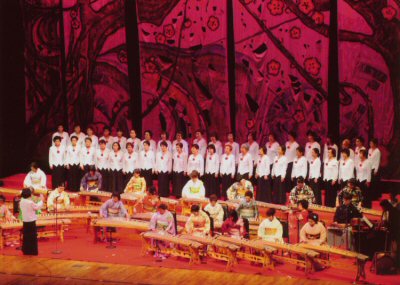
 
Koto Ensemble, Ruth Ratna Handy far right bottom

History of the Koto:
Historians think the zither was born around the fifth to third century BC in China. Originally it had only 5 strings but increased to 12 strings and then to 13. It was this 13-string zither that was carried to Japan during the Nara period (710-794) as an instrument in the imperial court. Although related to the Chinese and Korean zithers, the Koto has over time developed structural and musical characteristics that make it unique. There are 10 Degrees that can be earned in the study of the Koto as in other arts. With 5th Degree and a debut performance, a person can become a licensed Koto teacher.

Connection to the Moon Calendar:
When the Koto came into being, Asia measured months by the moon calendar. Every 4th year there would be a "leap month," rather than just a "leap day" as we have today. The thirteen strings stand for the 12 months of the year plus the highest and last string representing the 13th month of the leap year.

Yoko Awaya Koto Music Conservatory or Awaya Kai:
Students learn Michio Miyagi School of Koto techniques. All Koto performers are members of the Yoko Awaya Koto Music Conservatory and are under the direction and instruction of Madame Awaya who is a 10th Degree performing artist. The Conservatory is a non-profit organization dedicated to promoting the art of Koto and Jiuta Sangen music and to contributing to Japanese cultural awareness. The Conservatory hold biannual concerts with approximately 50 students, and its members have performed in over 1000 engagements throughout California and the United States.

For more information or to schedule a performance for an upcoming event, please contact:
Madame Yoko Awaya at (310) 329-5965.

 
Home | Back to Top

Ruth Ratna Handy, LCSW
kotolore@yahoo.com
818-834-5925